


Critics
Raul Córdula
Memoirs of the Skin
Deep in the soul, rest signals, icons, signs, and other archaic marks. Sometimes, however, they rouse, attain to life, and reveal themselves. And so emerge on the walls, in the wet cement of the sidewalks, in pieces of paper that are next to the telephones where speakers write unconsciously scribbles, on the sands of the beaches, rocks, everywhere. These are stony manifestations, the same as our prehistoric ancestors did to communicate, such as hand stamped soaked up with blood on the rocky walls of the caves, or the bison painted with charcoal and ocher or inscultures stelae of the Celts.
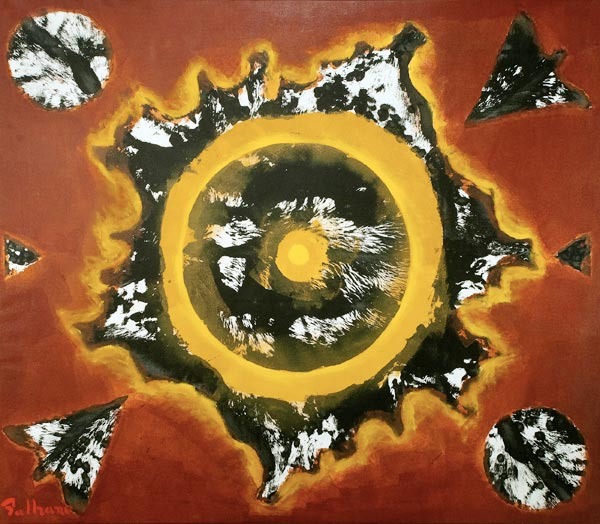
And so these are the series of paintings by Plinio Palhano. Materially the paintings are stamped with arrays of cow leather soaked with paint, as the hands of the ancient artist.
Analytically they are references to the ox, as did Picasso in Guernica, which he cites pictorially. The iconography refers to the war of flesh and the invocation of the warrior. The war as the image of the stony ox is manifested on the canvas, the invocation of culture as signs indicate African religious beliefs and rites.
This is an impressive work, the work of those who always renew themselves, integrant of the generation of great artists of Recife. A perennial professional who represents the most enduring traditions of Pernambuco art: painting.
Raul Córdula
Mare Nostrum
Mare Nostrum, this series of paintings by Pliny Palhano referring to the abundance of the sea, "the womb of the world," as Vanildo Brito, a poet from Paraíba, wrote in the Odes to Cabo Branco. Fish, visual theme of these paintings clearly inspired by the miracle, are the record of his urge to painting, his work and his ecstatic marked by quantity. Without directly observe what goes into the sea, he paints the shoals and movements in a way that, even taking photographs as a model, convey the elegance of its pictorial gestures, the same that we used to see at other moments of his art.
Painting is the symbol of the visual arts. With painting man communicates ever, and is moved contemplating his making, working and thinking.
Religiousness is appellant at the paintings by Plínio. Recently we saw at the State Museum an exhibition of large canvases devoted to myths and symbols painted differently, and stamped with stencils, but carrying the same rate of stroke awareness, but at the same time loaded with an unusual freedom that makes us think in rites without dogmas. In them were also references to prehistoric art, shamanistic events that seem to be stamped in our unconscious back to the cult, to the mystery and magic as it was and it is Christianity in its deepest mysteries, like the ancient memory of blood and body transformed into bread and wine.
+55 81 99138-8606
© 2026. All rights reserved.