


Critics
Ângelo Monteiro
Mare Nostrum: Esthetic and Ethic Legacy of Fish in Plínio Palhano
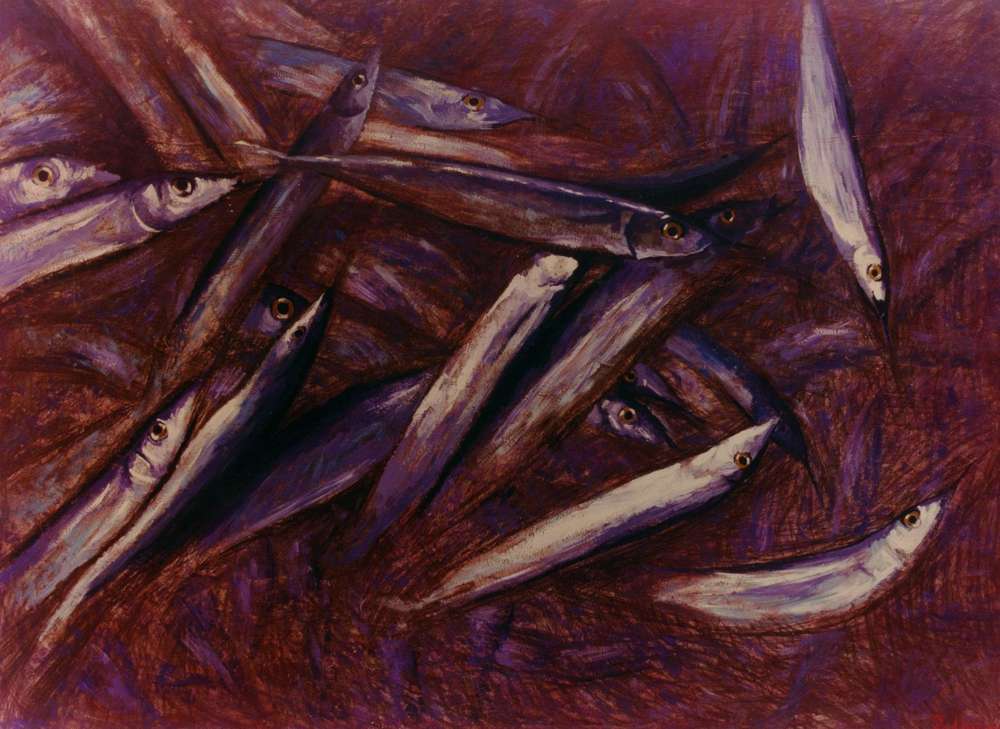
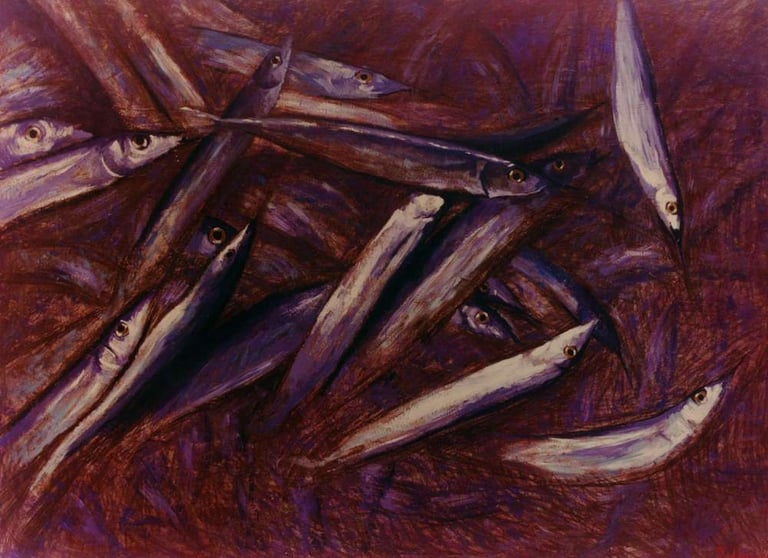
In its newest series, Mare Nostrum - composed by thirty-four canvases - fish's presence is, in principle, multiplier. As if it were protofish or ancestral fish presence that gave origin to all the other species or participating in the actuality of those, diverse, through which, one day, he came to light. Therefore, Fish, due to the vivifier light that caress him - in the colors of its multiples shoals, as well as in its multiple scales - reminds us as much the history of Christianity and its founder - which ordered that his apostles (among them were fishermen) became men's fishermen - as man's trajectory in Mare Nostrum on behalf of conquest and people's discovery.
In the canvases of Plínio Palhano fish passivity, inseparable from sea movement, cover itself with various forms, all of them under the command of our passions or the passion that the painter himself inspired. So, in its dance's symmetry and in its eyes whose shine is agonizing, as well as in the quality of still life in a dish - art, donation and food -, where the fishes acquire first a bloody (red) coloration, and then white in a black back - a veiled advertisement to life destruction in seas -, we have a work in continuous movement, that does not stop neither before the benevolence of solitary fish, sacrificing itself to world, among greens, to be served to men, nor before the reiterated remembrance of the same marine back, its colors varying between black, violet and red, in all its symbolic gradation.
Other forms and species, such as mollusks, shellfishes and starfishes blend and join together in Mare Nostrum's fauna. However, fishes' eyes and its yellow globe, its dark or blue pupils and its sighing or resigned mouths, inviting us to a reflection about ourselves more than to a reflection about themselves, is dominant.
The various combinations among the forms emphasize the several means of Mare Nostrum: however, what they transmit us as a permanent legacy, mainly, is its silent language, of what was not written, of what will be, eternally, a visionary salvation, as well in aquatic and mobile space as our common history's time.
The sea - shell or aquarium of everything - is the great receptacle, in its extreme chromatic variation, in tireless dance of forms that bathe in him, searching its center inside them but having in fish - in its iridescent sense of multiplication - its real center.
What does Plínio Palhano intend with Mare Nostrum, this transfigured and transformer work? Precisely transform us, make us see beyond ourselves, and learn, together with Santo Antonio de Lisboa, to hear fishes: because, certainly, they will hear us more than the so-called present men. From this modernity, always repeated, in several epochs and situations, in men's history.
If men are earth salt, as said Jesus - the fish for excellence - not everyone, however, accomplished the mission. Santo Antonio's sermon, preached by the priest Antonio Vieira in Sao Luis, Maranhão, in the distant year of 1554, continues to be current, but it's enough these words of sermon: "You will know, my brothers fish, that the salt, as you sea's sun, has two proprieties, that in you yourselves one sees: conserve the healthy and preserve him in order that he does not be corrupted".
These words of the priest Vieira, together with esthetic example of Plínio Palhano, are, at one time, witness and advertisement about the salt that conserves life and art's life, life that will only exist if it will have transfiguration and, then, if the conversion of real in one light bigger than he himself comes about.
Angelo Monteiro is Poet and Essayist
Ângelo Monteiro
COMPOSITIONS OF NUDITY
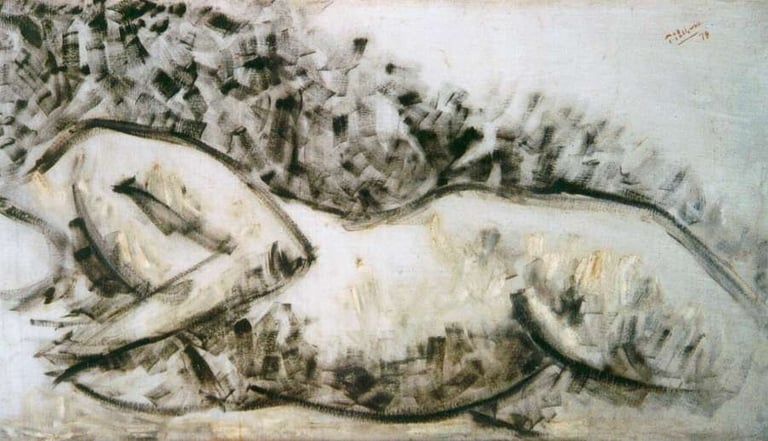
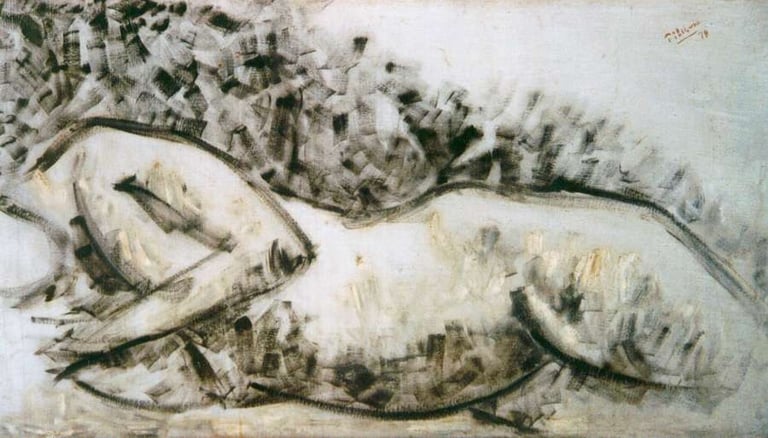
By taking the nakedness as a pictorial pretext, Plínio Palhano makes it, at the same time, into a reflection of reality and a starting point for his expressionism, merging a need of formal expansion - starting from the sensible world - with an abstract refusal to linger on the experience offered by these shapes themselves.
His studies have double direction: now they stress determinate volumes - thighs, breasts, buttocks - enriching its erotical component, now they dematerialize to just seek a play on lines and shapes in which the ochres and blues, and scarcely the red, will come to add to point out the charge of abstraction.
The nudes' face is always hidden, and this cover-up now aims at the emphasis of the parts or volumes, now the possibility of creating new shapes starting from the known forms, in a paradoxical eroticism which is first and foremost escape than fusion with things that offer themselves to the greed of the artist's eyes, hands and brushes.
For one thing, such a nakedness bears no resemblance to the nudes which gave it birth, then taking place the valorization of separate aspects of each shape or volume in itself, regardless of the whole, as if each aspect were worth for itself.
For another, we delve - together with the painter - into the bafflement of a world in which both the sensation and the escape from the sensation have similar heft, as if the possession or the refusal of things were two indifferent moments of an existential process changed into an aesthetic process.
Thus, in Plínio Palhano we have a seismograph of the contemporaneousness: the absence of the face of these nudes is a symptom of the breach of identity in the simultaneous encounter and loss of the visible shapes which gave themselves up to the artist's senses as if in an endless search.
Ângelo Monteiro
The Fire Code
Plínio Palhano´s art is bewildering and baffling.
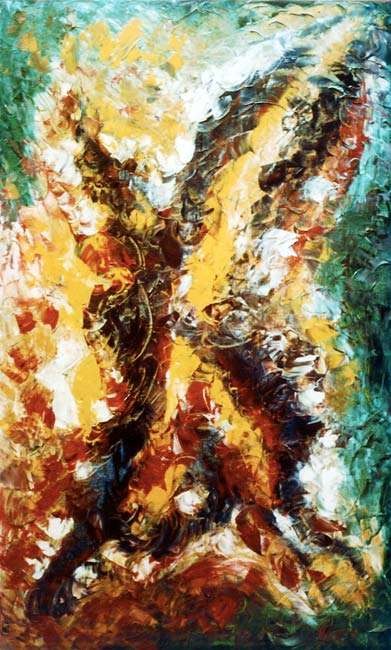
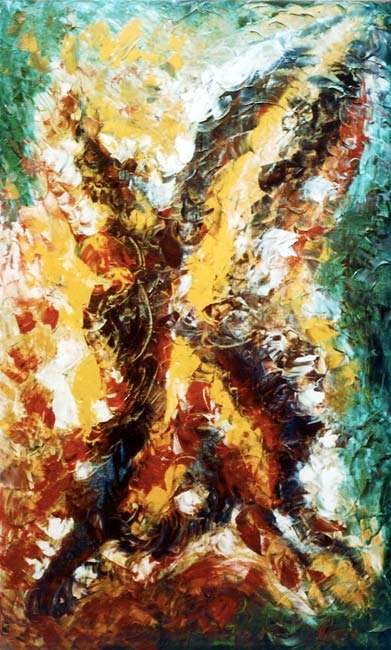
He is one of these artists who, in spite of their high level of information, they will never perform a derivative art. Thus, his painting forms a whole instauration starting from his own view of Reality, and, in this respect, it is predominantly visionary. The shapes seem to be submitted by his genius to a process of ongoing recreation, never allowing itself to fit in with any fixed or finished model. It is a deluge of colors or a code of fire, of an immemorial fire that seems to reactivate lost and forgot messages and, at the same time, suggests the birth of something completely new and overwhelming to our conscience or our watchful unconscious.
Expressionism and Impressionism fuse into the same painter. We can never say whether it is the abstraction or the dream the most important aspect. But in his painting one realizes a strained and wakeful vision on the things which, in their continuous change, renovate themselves perpetually in front of our eyes. Richness and vitality overflow lavishly, from every of his brushstrokes, stunning us and disquieting us with the powerful lavas of an inner volcano. Painter above all, magician and visionary, Plínio, nevertheless, preserves the presence of certain constants or archetypes like flames or mandalas, floral or stellar games, human shapes and strange animal shapes crossing each other as if they were on a carpet heavy with a living and hallucinatory fire that does not stop, but seems to spread beyond the limits of his canvases.
The tropical nature is also to be found in certain living suggestions which demarcate distance from the photographical realism so common to a determinate part of our painting. This happens because Plínio Palhano is more worried about the shape or the being of the things than the immediate matter through which things manifest themselves to us. By creating an art full of sensibility, Plínio, nonetheless, does not confine it to the webs of the sensible, reason why his Painting opens itself to a correspondence with other arts like Music and Poetry, inner messages where it finds its way of being. Dominating the skill of painting like few, one never feels him as if he were a technician who makes a pretext of his themes to fulfill a cold and neuter craft. For in him the luminous surpasses the merely technical, because Plínio Palhano feeds on light, color, sun and life and on light, color, sun and life he feeds his painting. Atemporal, non-spatial, the great painting by Plínio Palhano is opposite to the hardworking exercise of those who just view art from a strictly rational perspective. For this very reason, each of his paintings conveys amazement and uneasiness, stuff the great art needs to exist and allow man survive through it.
+55 81 99138-8606
© 2026. All rights reserved.